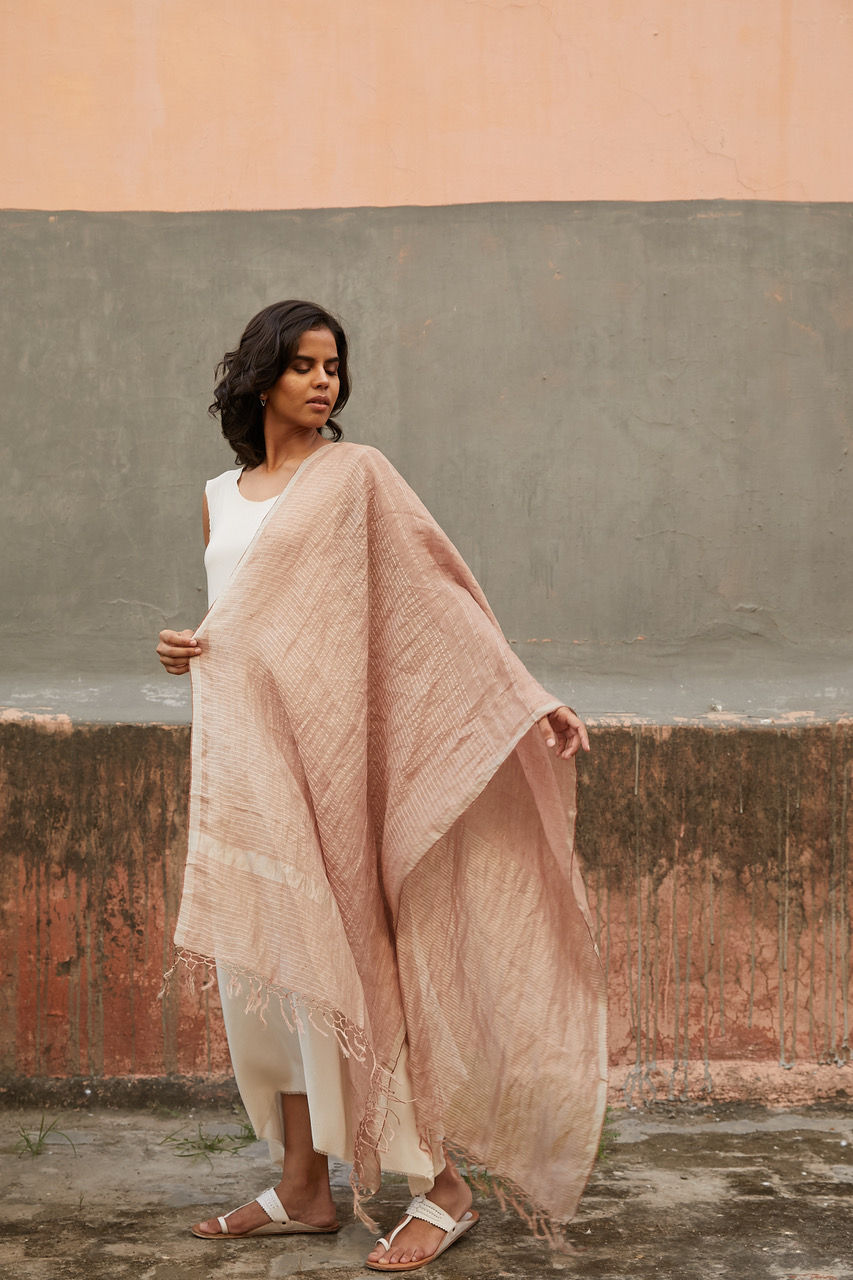

This scarf is gauzy, lightweight, and softly luminous. This handwoven linen scarf or wrap drapes effortlessly, catching the light with its delicate metallic zari stripes. Wrap yourself in its understated shimmer and gentle texture.
- Crafted from breathable linen with silver metallic “zari” stripes that glint subtly in motion
- Feels soft and featherlight against your skin
- Designed with refined contrast selvedge and hand-finished fringe details
- Handwoven by skilled rural artisans in Phulia, West Bengal, India. Only the more experienced weavers like Jhuran Das, pictured here, can weave such gauzy linen as the yarn is more brittle than the cotton they are used to, and thus more difficult to weave
- Generous dimensions for versatile styling: 30" x 84" - wear as a stole, scrunch up as a scarf, or wear as a light summer shawl draped over a simple summer dress. Dress up a simple white shirt and jeans.
TEXTILE & CARE
- Fabric: 100% linen
- Handfeel: Super light and delicately textured, semi sheer
- Care: Gentle hand wash separately in cold water. Do not soak. Gentle steam iron. Drip dry flat in the shade
Textile Story
My source partners with a Weaving Society, set up in 1958 in Phulia, West Bengal, to hand weave this beautiful cloth. Only the more experienced weavers like Jhuran Das, pictured here, can weave such gauzy linen as the yarn is more brittle than the cotton they are used to, and thus more difficult to weave.
Linen is made from the flax plant and is one of the oldest fibres used by man to create textiles. Once harvested, the flax stalks undergo a range of processes to create a fibre that can be spun into yarn: the stalks undergo a fermentation process known as retting, then drying, crushing and beating.
Linen is a strong cloth which dries quickly, making it a great conductor of heat - it is a perfect fabric to wear in hotter weather. It has low elasticity which gives it a smooth texture and makes it easy to wrinkle. We love the look of a crushed linen garment!
Our yarn is sourced from India's first and premium linen producer, Jayashri Mills. The yarn is dyed and starched, and spun onto bobbins. It then goes through several pre-loom processes to prepare it for the loom: denting, drafting and drumming. It is next loaded onto the loom where the design is set. Jhuran and his fellow weavers sit at pit looms where they turn this yarn into exquisite cloth.
Any variations or irregularities are part of the design and inherent to the production process.