top of page

About: About
MY STORY | Why I chose handmade textiles

Preeti Mehta
The standard that guides my work
Premaasi is a handmade textile house. My products are selected for material, technique, feel and the integrity of how each piece is made. I curate handmade scarves, shawls, sari silk necklaces, garments, and textile-based pieces for both the wardrobe and the home. The textiles are all created by skilled artisans.
This page explains how I came to hold that standard, and why it continues to guide my work today.
Growing up with handmade textiles
When I grew up in India, clothing didn’t begin as a finished product. You bought fabric and had your clothes tailored. Much of that fabric was mill-made and sold in fabric shops.
But what stayed with me was the cloth that felt different the moment I touched it. Hand–block printed cotton that softened with wear. Hand-embroidered cloth where every stitch was imperfectly perfect. Hand-painted or hand-woven fabric whose color texture and pattern could never be repeated.
Craft as a Way of Making
Over time, I learned to recognize what worked. Not what was new or ornate, but what carried weight, movement, and presence. I didn’t have a language for it then. I just knew. I came to understand craft as a way of making textiles that have visual presence but also work for the specific purpose for which we choose them. That understanding still guides how I choose my products. It's how I still understand value.
I don’t separate textiles by category. I look at the work. The same cloth that makes sense worn on the body can also belong in the home, like my kantha sari napkins and my kantha sari shawls - same technique, same standard, but different fabric and context.
State-run handloom and craft emporia once made handwork part of everyday life. They showcased regional textile traditions not as artifacts, but for daily use.
Those institutions still exist in various forms today. But the environment around them has changed.
Working Within Today’s Market
Handmade textiles now operate in markets built for speed, scale, and homogeneity. Artisanal skills are better and evolved for a more urbane market. Artisans continue to produce extraordinary work. What’s harder now is creating the space for more people to find this work and appreciate it.
That is the challenge I take on with Premaasi Textiles - bringing textile work shaped through craft into modern wardrobes and homes, without asking it to become something it isn't.
Bringing handloom and handmade textiles into international markets is demanding. You can't standardize one-of-a-kind pieces. Traditional techniques do not fit into modern retail systems.
I have chosen to work within these realities.
Why This Work Endures
Women make much of the work I source today or they support their husbands in the weaving, spinning yarn, or bandhani (tie-dye) work. They are often from low-income households. In some cases, they are primary earners for their families.
The work endures because it fits real lives. Much of the work is home-based. Women have the flexibility to complete household chores while doing the work.
That reality matters to me and is, in part, how I decide what kind of work I will support and bring forward. When the work sustains a household, it remains alive and relevant.
I built Premaasi by choosing products guided by my beliefs and passion. I curate scarves, shawls, sari silk necklaces, garments, and textile-based pieces. Skilled artisans make them using time-honored techniques and natural materials.
Nothing here is produced at scale. Nothing is replicated exactly. I choose pieces that hold together materially, structurally, and visually. Not because they follow a trend.
Premaasi exists to ensure this work remains viable by allowing it to be worn, used, and chosen again. This allows the people behind it to continue doing what they know how to do best.
This textile house is for women who notice the difference and know that their choices sustain work done well, over time.
Please read my Sustainability Guidelines here.
What's in the name, anyway?
Premaasi is short for "Preeti Maasi". Maasi is "mother's sister" in Hindi. The name Premaasi is inspired by my community, both young and old that warmly call me "Preeti Maasi". In a small way, Premaasi Textiles aims to make the world a better (and more beautiful) place for them.
Want to “feel like you’re wearing art, and look and feel terrific”? Browse the collection here.

With brothers Imran and Zuber Khatri of Zia Bandhani and their families

Creating my kantha sari napkins
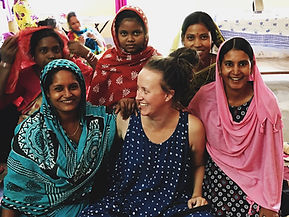
Sari silk kantha scarf artisans with Katherine of House of Wandering Silk

Woman at loom in Bhujodi, Kuchchh, Gujerat
bottom of page