top of page

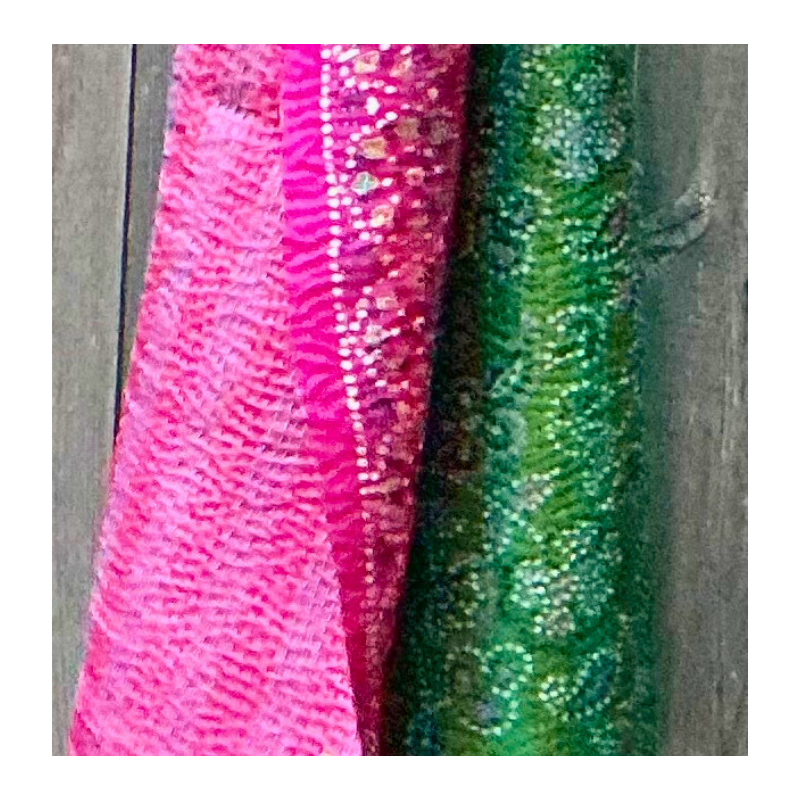
Created by tying tiny knots in the fabric in a predetermined pattern and then dyeing. The knots are untied after the fabric has been dyed, washed and dried giving the scarf it's beautiful textured look. This technique of bandhani (India's answer to tie-dye) is very similar to Kanoko shibori, a Japanese tie-dye in which very tiny bits of cloth are bound with thread to create "dots" in a specific pattern. Japanese kimono cloth is dyed this way.


  • 100% silk
  • pattern created by using bandhani (Indian tie-dye) surface design technique. Dimensions: 21" x 84"
  • Created in Kuchchh, Gujerat, India by veteran artisans who have received the UNESCO Seal of Excellence for 2006 and 2007, been invited to the Santa Fe International Folk Art Market many times. They have been finalists for the International Folk Art Alliance Living Traditions Award.


Any variations or irregularities are part of the design and inherent to the production process.


Story:


Bandhani is one of India's oldest textile arts. The word comes from the Sanskrit bandha — meaning "to tie" — and the technique dates back more than 5,000 years to the Indus Valley Civilization. It is practiced today only in the regions where it was first developed: Sindh in Pakistan, and the states of Gujarat and Rajasthan in India.

The process is entirely done by hand. A craftsperson takes the smallest possible pinch of fabric between two fingers and wraps thread tightly around it. That pinch is repeated — one by one, across the entire surface of the fabric — in a predetermined pattern. The fabric is then dyed. Where thread was wrapped, the dye cannot penetrate. When the threads are removed after dyeing, washing, and drying, they reveal a field of tiny dots in the pattern that was tied. The smaller and more uniform the dots, the more skilled the hand that made them.


This scarf was made by artisans at SIDR Craft in Kuchchh, Gujarat — veterans of the bandhani tradition who have received the UNESCO Seal of Excellence, been invited to the Santa Fe International Folk Art Market multiple times, and been finalists for the International Folk Art Alliance Living Traditions Award. Their work is not produced in volume. Each piece takes time that cannot be shortened.


The cobalt blue color of this scarf comes from the dye bath after tying — the resist of each tiny knot is what creates the dot pattern you see. What looks like print is entirely texture. You can feel every tied point in the fabric.


This is bandhani as it has always been made: in Kuchchh, by hand, one knot at a time.

tiny dots - blue bandhani scarf

$105.00Price
Quantity
  • Please treat this handcrafted product with the utmost care.

    To care for your 100% silk scarf, please wash separately in cold water, using a mild detergent, but only if necessary. Do not soak. Drip dry in shade. Spot clean first if possible. 

    Note that washing my result in "flattening" out the puckered, textured fabric. 

  • 100% habutai silk

    22" x 76"

Related Products

bottom of page