
Why Strangers Keep Stopping My Customers to Ask About Their Handmade Silk Sari Necklaces and Silk Sari Kantha Shawls
- Apr 15
- 7 min read
Updated: Apr 18
The upcycled sari silk necklaces and silk sari kantha shawls that start conversations wherever they go
Betty started with one sari silk necklace. She now has seven.
Kathryn couldn’t pick just one, so she bought four.
Barbara couldn’t take her eyes off a kantha scarf an acquaintance was wearing. She bought three.
Donna paired a kantha shawl and a sari silk necklace as a birthday gift for her sister. Her sister gets compliments every time she wears them.
I hear versions of these stories constantly. Someone wears a piece and gets asked where she got it. That question is how most of my customers find me. It's usually because they saw something handmade and unique that stopped them mid-conversation.
I run Premaasi Textiles, a small handmade textile house based in Massachusetts. I source scarves, shawls, necklaces, and garments made by skilled artisans in India.
But the two products that start the most conversations share the same origin: vintage sari silk. One becomes a necklace. The other becomes a shawl.
With Earth Day approaching, it feels like the right time to explain what these pieces actually are, where they come from, and why they matter.


The Life of a Sari Before It Becomes Something New
In India, a sari is not just a garment. It is six to nine yards of unstitched fabric that a woman drapes around her body. Saris are worn daily, passed between generations, given as gifts at weddings, and chosen with care for festivals, ceremonies, and everyday life. A single sari might be worn for years before its owner might decide she wants to pass it on.
When a sari reaches that point, its journey is only beginning. In parts of India, sari traders go door to door, trading household utensils for old saris. The image is vivid if you’ve never seen it: a woman with utensils piled high on her head, knocking on doors, negotiating for cloth. The saris she collects are sorted and sold to sellers on the pavements of cities like New Delhi, where designers and artisans select the ones with the most interesting colors and patterns. (Tourists buy these too and they become part of a DIY textile art or craft project somewhere in the world).
From there, the saris are cut into pieces (the worn parts discarded) and layered, two pieces of vintage silk chosen for their colors, and hand-embroidered with kantha stitching to become shawls. The remnants from making these kantha sari shawls become the wrapping for the beads. Sometimes the same sari does both. Nothing is wasted.
This is upcycling in its truest form. These pieces exist because of a tradition of reuse that long predates the word “sustainability.” Women in India have been repurposing old cloth for centuries. The necklace and the shawl are simply two of the newest expressions of that practice.
The world produces 92 million tons of textile waste every year. India alone accounts for nearly 8 million tons of that. The saris that enter the upcycling chain I work with would otherwise join that number.
Instead, they become shawls and necklaces. These two are the most sustainable products I sell at Premaasi Textiles.
The Silk Sari Bead Necklace: The Color Without Weight
A sari silk bead necklace is made from very lightweight wooden beads wrapped in remnants of upcycled sari silk. Each bead is individually wrapped by hand. Each strand is assembled by hand. There is no machine involved. Because each necklace is made from a different sari, no two are alike. The colors, patterns, and textures on yours will never be repeated.
I carry them in single-strand, 3-strand, 5-strand, 6-strand, 12-strand styles and more. A single strand can be worn long or wrapped multiple times for a layered look. The multi-strand versions create a fuller, more dramatic effect. All of them weigh almost nothing.
The layered, multi-strand style has a well-known champion. Iris Apfel, the style icon who built a career on the principle that “more is more and less is a bore,” was rarely seen without oversized layered necklaces mixing bold colors and unexpected materials.
I carry an “Iris” style in my collection: a sari silk bead necklace with oversized beads and vibrant, contrasting colors that nods to her fearless approach to accessories. Apfel understood something my customers discover on their own: a bold necklace over a
simple outfit isn’t overdoing it. It’s the outfit.

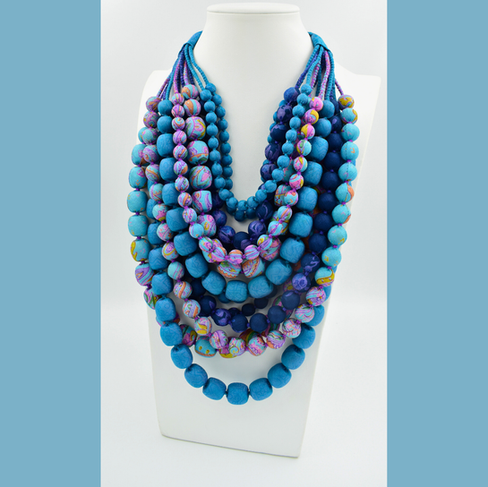


Put on a plain black top and a pair of jeans. Add a 5-strand sari silk necklace. You have an outfit. The necklace supplies the color, the texture, and the interest. It goes with white, black, navy, gray, denim, and linen. It works at a weekend market, a casual dinner, or a Tuesday morning when you need to feel a little more put together than your mood suggests.
Betty M., one of my customers in New Hampshire, puts it simply: “I am wearing art, feel and look terrific.”
The Silk Sari Kantha Shawl: 3,000 Years of Stitching
Kantha is a tradition of hand embroidery with a history of over 3,000 years. It started as a way to stitch together old cloth, giving worn fabric new strength and purpose. Today, it is practiced by women in West Bengal who spend days, sometimes weeks, on a single piece.
Each kantha sari shawl is made from two layers of vintage silk sari fabric, carefully chosen for their colors and patterns. The kantha stitching, a simple running stitch worked across the entire surface, holds the layers together and adds a puckered texture you can feel with your fingers. It is reversible. It is one of a kind. And once it sells, it cannot be repeated, because no two vintage saris are the same. Each shawl is embroidered with the initials of the kantha embroiderer, just as artists might initial a painting.
The shawl does something different from the necklace.
Where the necklace is a quick finishing touch, the shawl is a layer. It drapes over your shoulders at a cold restaurant. It wraps around you on a chilly flight. It turns a simple dark outfit into something people notice across the room. It is silk, so it has weight and movement without bulk.
Donna K., who paired a kantha shawl and a sari silk necklace as a birthday gift, describes the reaction: “She loved it! It was a beautiful and memorable gift knowing it was hand-crafted and supporting women and their culture. She receives multiple comments every time she wears them.”







The People Behind the Pieces
Both products, the sari silk bead necklaces and the silk sari kantha shawls are made entirely by hand, by artisans in India. Many are women, often from low-income households. For some, this work is their primary source of income. The work is home-based, which means they can complete it alongside household responsibilities.
When I choose which products to carry, the livelihood question is always part of the decision. I look for work that sustains the people who make it. The necklace is beautiful because it is well-made by skilled hands. The shawl is beautiful because a woman spent weeks stitching it with care. The fact that buying these pieces supports real households is not the selling point. It’s the context.

What This Has to Do with Earth Day
Earth Day is April 22nd. Every year, it brings a wave of messaging about sustainability. Some of it is meaningful. Some of it is marketing dressed up in green.
I want to be straightforward. These are zero-waste products. The silk comes from saris that would otherwise be discarded. The wooden beads are a natural material. The kantha stitching uses simple cotton thread on existing fabric. Nothing is produced at scale.
They are not going to save the planet. No single purchase will. But they represent a way of making things that is fundamentally different from how most fashion accessories are produced. No petroleum-based plastics or microfibers. No faceless humans closeted in a factory, but actual people in a village in West Bengal, or a studio in New Delhi. Just silk that already existed, hands that know what they’re doing, and a tradition of reuse that has been working for centuries.
If you’re looking for a way to mark Earth Day that goes beyond a hashtag, wearing something made this way is one option.
Telling the story when someone asks is another.
Wearing a Sari Silk Bead Necklace and a Silk Sari Kantha Shawl Together
The necklace and the shawl share an origin but serve different purposes. The necklace is the piece you grab on the way out the door when your outfit needs one more thing. The shawl is the piece you reach for when the evening turns cool or when you want presence without planning.
Several of my customers wear them together: a bright necklace visible at the neckline with a shawl draped over the shoulders. They pair well because they don’t compete. Together, they finish an outfit from two directions.

The Question That Keeps Coming Back
Almost every testimonial I receive includes some version of the same story: someone else noticed. Someone asked. Someone wanted one.
“It was love at first sight! When I saw the silk-wrapped beaded necklace on the neck of my new friend, I knew I needed it. — Cindy M., Kansas”
“I couldn’t take my eyes off the kantha scarf an acquaintance was wearing. I bought three. — Barbara B., D.C.”
“Everyone loved both the beads and the shawl, and when I told the story, all wanted to know where to get them. — Jessie K.”
These pieces always strike a chord with people that see them. And it's not because they follow a trend. It's because they're unique, real and meaningful. The silk had a life before it reached you. The hands that made it are real hands. And the colors are the kind you can’t get from a machine.
If that’s the kind of piece you want in your life, or in someone else’s, I’d love for you to take a look.
This Earth Day, every upcycled sari silk necklace and kantha shawl on my site is buy one, get one at 50% off. Two one-of-a-kind pieces: one for you and one as a gift, or both for yourself.
The offer runs from April 22nd, 2026 at noon, EST through April 24th at midnight EST.
Click the button on this page to sign up to be notified when the Promotion is LIVE


Comments